Ayuma BeHar HaMor
| This is HoraWiki, a treasury of Israeli folkdance information that anyone can edit! To get started, visit the Home Page. |
Hebrew: איומה בהר המור
The phrase "Ayuma behar hamor" is the first line of several poems in the Diwan, the semi-sacred collection of poems and songs compiled and mostly or entirely written by Rabbi Shalom Shabazi, 1619–1720, who was known as the "Poet of Yemen". A list of dances whose music uses lyrics from the Diwan is here, and more information on the Diwan is here.
The poems beginning with "Ayuma behar hamor" all begin with the following lines:
.איומה בהר המור עלי לך ובשרי
.ונשיר בשיר מזמור. בנגון ליוצרי
Ayuma behar hamor ali lach uvaseri.
Venashir beshir mizmor. benigun leyotzeri.
. . . after which they differ. Here are the dances whose music uses one or another of these poems:
- Ayuma BeHar HaMor, the most common, is an easy circle dance by Amnon Shauli, 1983. The Diwan page containing this version is here.
- Amalel Shir, circle dance by Shlomo Maman, 1981. The Diwan page containing this poem is here. (Only some of the lyrics appear, at the bottom.)
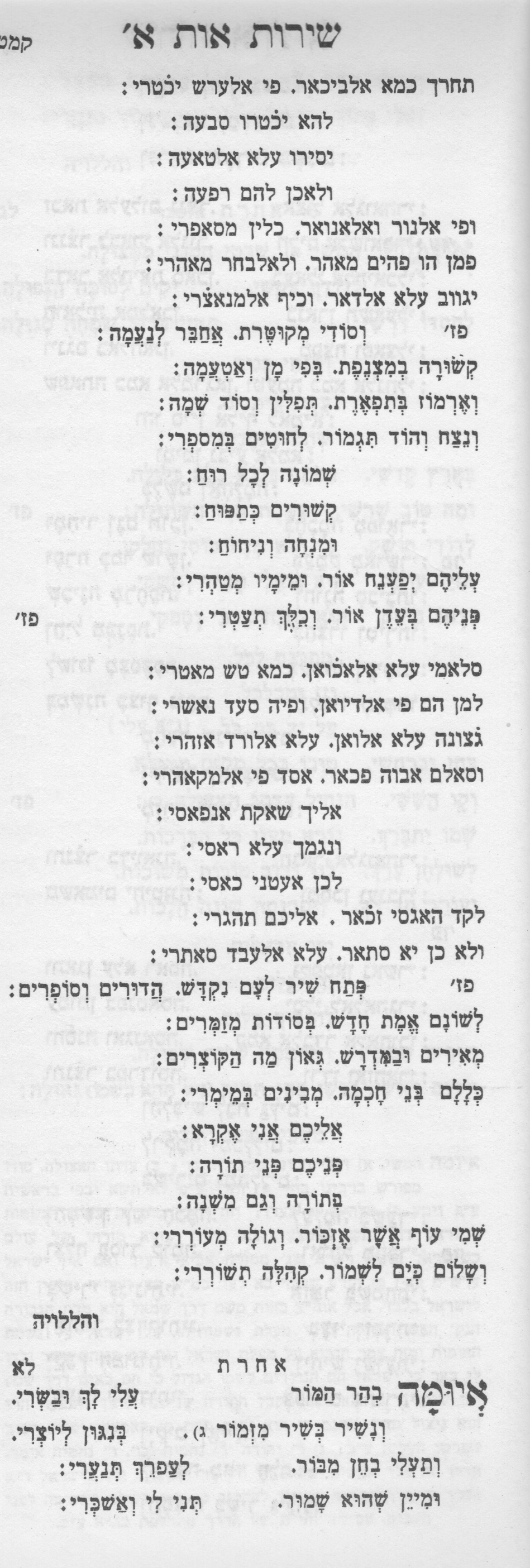
- Ayuma, individual dance (circle formation without handhold) by Moshiko HaLevy, 1991. The Diwan pages containing this version are here. (The first and fifth verses are sung.)
- Sabaya, circle dance by Gadi Bitton, 2022. It is not clear whether the song uses any lines other than the first two above; the other lyrics may not be from the Diwan. But it's possible that there are some lyrics from the same poem as is used by Ayuma BeHar Hamor. Although the word "sabaya" in Arabic can mean "young women", in this context it refers to a Yemeni layer cake (see link below).
The phrase "Ayuma behar hamor" is very hard to translate. As we see in the notes on the page for dance Ayuma, "ayuma" refers to the Shechina, the immanent presence of God as experienced by humankind. Therefore it includes aspects of radiance and splendor, but also of awesomeness and even terror. (The words is sometimes translated as "disaster" but that doesn't seem appropriate.) Har HaMor, literally "the mountaiitn of myrrh", may be Mount Moriah, but it may also be an allusion to Mount Sinai. And poetically it may be both at once.
A note on pronunciation: In the second line of the poem, the letter gimel of the word "nigun" contains a dagesh, a dot. (Reason: It comes from the verb לנגן in binyan pi'el, a so-called "heavy" binyan, where the second letter receives a dagesh if possible.) Just as this dot in modern Hebrew makes the difference between "b" and "v" or between "p" and "f", dagesh in Yemenite Hebrew changes the "g" sound to "j". Furthermore, the prefix "ו", meaning "and", is pronounced not as "v" but as "w". So listen carefully to the singer. If in the second line you hear "w'nashir beshir mizmor, benijun leyotzri" you know that the singing is authentic.
External Links
Ayuma BeHar HaMor at israelidances.com
Amalel Shir at israelidances.com
Video at Rokdim
Sung by Avner Gadasi
Easier-to-read lyrics
Ayuma at israelidances.com
Video at Rokdim
Easier-to-read lyrics
Sabaya at israelidances.com
Video at Rokdim
A recipe for Sabaya